

Several qubit technologies are competing to build useful quantum computers, each offering distinct features and strengths. Superconducting circuits currently lead in the number of qubits per QPU, while silicon spin qubits show great promise for scaling but are earlier in their development cycles. This post explains why - for utility-scale quantum computers - the trajectory matters more than the current snapshot, and why silicon's speed, power efficiency, manufacturing and density advantages become decisive at scale.
Why silicon is the foundation for scalable quantum computing
Several approaches to quantum computing are making progress. Superconducting circuits, trapped ions, neutral atoms, and silicon-spin qubits have all demonstrated high-fidelity qubit operations in recent years.
The question that separates them is not just which can reach the highest qubit count in the laboratory, but which can deliver millions of qubits at the cost, power consumption, and with the gate operation speed required for commercially useful machines.
Silicon spin's case rests on a combination of practical advantages: operational speed, qubit density, power efficiency, a proven track record in manufacturing uniform devices at volume, and the depth of existing knowledge about the material.
Building a useful, fault-tolerant quantum computer will require millions of qubits manufactured with high uniformity, and this is where silicon's advantages become difficult for other platforms to match.
Read: Silicon Spin Qubits: How Transistor Technology Becomes a Quantum Computer
Silicon: A material with 60 years of engineering maturity
The global semiconductor industry has been working with silicon for over six decades. The fabrication processes, materials science, and device physics are understood at a level of detail that has no equivalent in any other qubit platform.
This depth of knowledge matters because quantum devices in silicon are still challenging to build. Charge noise, variability between devices, and the precision required to trap and control individual electrons all present real difficulties. What makes silicon distinct is that these difficulties are well-characterised. They show up in measurements we can interpret, and they respond to engineering interventions we can iterate on systematically. The diagnostic infrastructure already exists.
Our Bloomsbury chip demonstrated this concretely. The team created arrays of over 1,000 quantum dots, all individually addressable and measurable, manufactured on a standard 300mm CMOS process. The subsequent Hoxton chip measured quantum states of electrons within those dots and used them to form the basic elements of a quantum processing unit. In Hoxton, we also developed compact super-inductor resonators for readout of the qubits (over 10,000x more compact and over 100x more sensitive than other methods). With each chip generation (see roadmap below), we have deepened our knowledge of how CMOS electronics behaves at cryogenic temperatures, allowing us to build low-temperature ICs with increasing levels of complexity and performance, while also deepening the integration between our qubits and the ‘classical’ control and readout electronics.
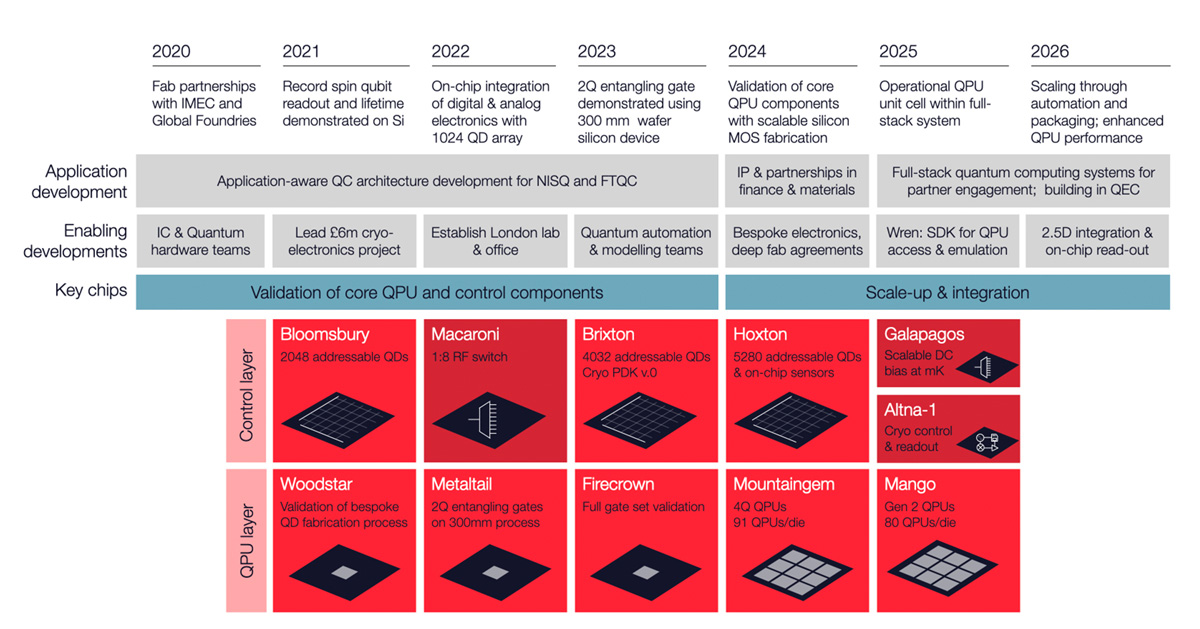
Quantum Motion’s Chip Development History
Speed, density, uniformity, and reproducibility at volume
A quantum processor with millions of qubits cannot treat each one as a bespoke, individually tuned instrument. The challenge shifts from making one excellent qubit to making many qubits that behave consistently.
Silicon has a track record here. The global chip industry produces billions of near-identical transistors on a single die. A modern smartphone processor contains over 100 billion functioning components, each manufactured to nanometre-scale tolerances. Silicon spin qubits are fabricated using the same CMOS processes and the same foundry infrastructure, including partnerships with GlobalFoundries and imec, which means the tools for controlling variability at volume already exist.
Silicon spin qubits are also among the fastest. When running fault-tolerant algorithms that require billions of error correction cycles, faster gate speeds translate directly into shorter runtimes. Quantum Motion’s internal benchmarking shows that on a representative chemistry problem, a silicon spin qubit system could complete the computation approximately 160 times faster than the equivalent trapped ion system.
This matters for qubit density too. Within our large-scale fault-tolerant architectures, silicon spin qubits have a density of roughly one per square micrometre. For comparison, that enables about 100,000 silicon spin qubits to fit within the area of a single superconducting qubit, based on typical densities in today’s QPUs.
The combination of speed and density produces a compounding advantage. Quantum Motion’s analysis shows that silicon spin qubits deliver approximately 2,000 times more logical operations per square centimetre of processor area than superconducting systems, even when using conservative assumptions for silicon’s performance and optimistic assumptions for competing platforms.
Control, power efficiency, and automation
Silicon spin qubits are controlled using gate voltages and high-frequency microwave pulses, the same types of electrical signals used across the semiconductor industry. This means that the control electronics can be built using stand CMOS processes and integrated directly alongside the qubits, rather than requiring bulky external hardware connected by thousands of cables.
This integration has a direct impact on power consumption. A silicon-based quantum computer with integrated cryo-CMOS control electronics consumes a fraction of the power of systems that rely on room-temperature control hardware connected via extensive abling. Quantum Motion’s architecture targets a 100-fold reduction in the cost and space requirements and up to a 1,000 fold reduction in energy consumption compared to other approaches.
Calibration, monitoring, and repeatable operation are enabled by the architecture itself. Gate voltage control lends itself naturally to automated calibration routines and machine learning-assisted tuning, allowing systems to be brought online and maintained without manual intervention at the level of individual qubits. These are essential steps toward usable systems that can be operated continuously, rather than one-off laboratory demonstrations. Quantum Motion has dedicated teams building exactly these capabilities, as demonstrated in the team's Nature Electronics publication on high-performance spin qubit readout.
Understanding electronics at cryogenic temperatures
Scaling CMOS quantum computing also requires understanding how integrated circuits behave at the extremely low temperatures where silicon spin qubits operate. Conventional CMOS electronics were designed for room temperature. At the sub-Kelvin temperatures where qubits run, transistor behaviour changes in important ways.
Quantum Motion's modelling team and IC validation team are developing new models of how integrated circuits and silicon spin qubits perform at cryogenic temperatures, work that is essential for designing control electronics that can sit alongside the quantum processor inside the dilution fridge. Through the FIRETRACE Prosperity Partnership which we lead with NPL and the University of Strathclyde, the team is building advanced tools for measuring and modelling the thermal behaviour of these cryogenic electronics.
The trajectory, not the snapshot
Silicon spin qubits may be earlier in their development cycle than superconducting or trapped ion systems, but they build on a manufacturing platform that is decades more mature.
The key question is whether the approaches leading on qubit count today will still lead when the industry needs millions of qubits manufactured at volume, operating at speed, and deployable within realistic power and cost budgets. Silicon spin qubits have the potential to offer systems that are not just fast, but denser, and more power-efficient than any competing platform at scale. Combined with the manufacturing maturity of the global semiconductor industry, these advantages position silicon as the foundation for commercially viable quantum computing.
The next post in this series makes this case concrete, showing what different qubit platforms would actually require to solve a commercially relevant problem, and what the resulting machines would look like.
Key facts:
- Quantum Motion’s silicon transistor-based architecture produces quantum computers with 100-fold reduction in cost and space requirements as well as 1,000-fold reduction in energy consumption compared to other approaches.
- Quantum Motion’s silicon spin qubits occupy approximately 1 μm² per qubit, compared to roughly 90,000 μm² for superconducting qubits.
- Quantum Motion’s silicon spin qubits are manufactured using standard CMOS processes in commercial foundries including GlobalFoundries and imec.
- Quantum Motion’s Bloomsbury chip demonstrated arrays of over 1,000 individually addressable quantum dots on a 300mm CMOS process.
- IC integration enables automated calibration and machine learning-assisted tuning for scalable system operation.